
The Guitar of Doc Watson

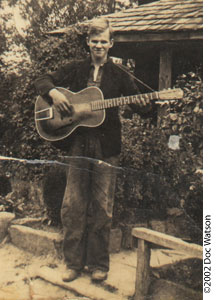
Doc Watson elevated the role of the acoustic guitar to the status of a lead instrument in American traditional music - right along side of the fiddle and banjo. Before Doc, the guitar was used primarily as a rhythm instrument in a supporting role. Doc raised the bar with his playing, and set a new standard for guitarists to achieve.
Doc was accomplished both as a flatpicker and as a fingerstyle guitarist. As a fingerstyle player, Doc used a thumbpick and one fingerpick (on his index finger) to play tunes. This "two finger" style was self-taught. Doc typically used the thumbpick for alternating bass accompaniment and the index finger for picking out notes or rhythmic fills on the treble strings. Doc commonly dampened the bass strings with his palm when he finger picked, producing a percussive, thumpy bass line. This is very evident on some of his well known fingerstyle recordings such as Deep River Blues, Windy and Warm and Doc's Guitar.
As flatpicker, Doc wa known for his speed, tone and precision. He used a down-up (DUDU) picking style, with down strokes on the downbeat and upstrokes on the upbeats. Doc's flatpicking technique used more arm motion (and less wrist motion) than most players. He also used his little finger as a depth guide for flatpicking. He let it glide on the pickguard when he was picking rather than planting it in one spot. Doc used a traditional tear-shaped nylon flatpick (1mm Jim Dunlop). He also used John Pearse phosphor bronze strings (medium and light gauges).
Doc's repertoire and instrumental style are a reflection of several musical influences from his childhood. These included traditional and sacred music he learned from his family and neighbors; phonograph records; and song and dance tunes he heard on the radio.
Doc grew up in a family rich in musical traditions. Some of his earliest memories are of his mother singing around the house. His father, a banjo player and vocalist, led the congregation's singing at the local Baptist church. Blinded shortly after he was born, Doc was naturally curious about music. He would play with anything around the house that would make a musical sound.
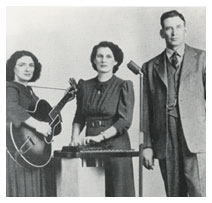
Some of the performers who have influenced Doc's style include:
Doc's style reflects the blend of these many musical influences. Throughout his recording career, Doc typically released albums that contain an assortment of musical genres, including traditional ballads, fiddle tunes, blues, gospel, country, and even contemporary songs.
Doc's first guitar was a Stella, which he got at age 13. He called it "one of those ten dollar guitars - a pretty good thing to learn on, but hard to fret as a barbed wire fence." (Gary Govert, Carolina Lifestyle, August 1983). At 17, he purchased a Sears Silvertone mail-order guitar with money he earned chopping wood with his brother. A year later, he traded up to a Martin D-28 with money earned by street busking.
By 1953, Doc was married and had two children. He started playing in a band with piano player Jack Williams to earn money to support his family. At that time he swapped his D-28 for a Gibson Les Paul electric guitar which he used with the band for the rockabilly style music they performed. Doc was still playing the Les Paul in 1960 when he was discovered by musician-folklorist Ralph Rinzler, who had come to the area looking to record Clarence "Tom" Ashley. It was Ashley who had suggested that Doc play guitar for the recording.
Rinzler knew that he had found a special talent in Doc, and convinced him that he had a future in the music business. His remarks in an early issue of Sing Out! (Vol. 14, No. 1, February-March 1964) proved to be prophetic:
"Doc's impact as a soloist will surely be profoundly felt, for there is hardly an artist in folk and/or country music who combines musical integrity with such total mastery of technique on several instruments, and such warmth and honesty of presentation."
Doc primarily used mahogany or sapele (African mahogany) guitars throughout his career. In his early recordings, Doc frequently used a Martin D-18, but in 1968 he began a long association with J.W. Gallagher Guitars. Doc began playing a Gallagher G-50 (serial #68001) in 1968 that earned the nickname "Ol Hoss." This is the guitar that Doc played on the Nitty Gritty Dirt Band's Will The Circle Be Unbroken album where Merle Travis comments that the guitar "rings like a bell."
Doc played "Ol Hoss" until 1974, when it was replaced by another Gallagher guitar. "Ol Hoss" was returned to the Gallagher company and was put on display at the Country Music Hall of Fame in Nashville, Tennessee for a while after that. In 2012 the guitar was put up for auction at Christie's and was sold for $40,000.
Doc's 1974 Gallagher guitar featured a neck profile like a Gibson Les Paul, which is what he wanted. It also had a voiced top, herringbone purfling and rosette, and an ebony fingerboard and bridge. Doc was very pleased with this guitar (serial #662), and it was named the Gallagher Doc Watson Model. In 1991, Gallagher made a cut-a-way version of the Doc Watson model for Doc (serial #2067). This is the guitar that Doc referred to as "Donald."
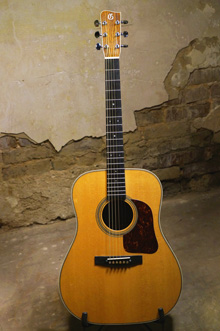
Gallagher Guitars currently offers a Doc Watson Model. It is built with African Mahogany, with a Sitka Spruce top, scalloped bracing, ebony fingerboard and bridge and bone saddle.
Doc was given other guitars during his life, including one built for him by Wayne Henderson in 2006, which he often played after receiving it. Here is a video of Doc playing the guitar at Wayne's shop when he picked it up.